


Tippy Money
Tippy Money was a weekend side project that explored a simple idea: could people send money through the social conversations they were already having?
Starting with Twitter as the beta platform, we created a lightweight way for supporters to tip creators without leaving the conversation. I led the product design and user research, while also contributing to the front-end build alongside one engineer.
The MVP attracted more than 200 sign-ups in its first week, processed over $1,000 in tips and was acquired around two months after launch.
Role
Product Designer and front-end contributor
Scope
Product strategy, user research, UX/UI design, illustration, brand and front-end development
Team
1 x engineer, 1 x product designer
Platform
Web, with Twitter as the beta platform
Period
Weekend MVP, acquired around two months after launch
Starting with one community and one complete tipping loop allowed us to launch quickly, learn from genuine use and prove that the behaviour had potential.
200+
Sign-ups in the first week
Early interest came from creators, indie hackers and people already supporting each other online.
$1k+
Tips sent through social interactions
Supporters could send money without leaving the conversation to begin a separate payment journey.
Acquired
Around two months after the MVP launched
The project moved from a weekend experiment to an acquired product within its first few months.
Supporting people online was becoming normal across streaming platforms and creator tools such as Patreon and Substack. Tipping, however, still felt separate from the places where people discovered work, shared it and celebrated it.
We saw an opportunity to make support feel native to social media. The proposition was deliberately simple:
One account
Multiple social platforms over time
An experience as easy as sending a reply
We started with indie hackers and creators building in public because we were already part of that community. They openly shared new work, celebrated small wins and supported one another. This gave us access to early users, rapid feedback and a realistic place to test the idea.
Research and beta testing pointed to one consistent behaviour: people wanted tipping to be simple, fast and public.
Moving supporters into a separate payment flow would interrupt the moment that prompted the tip. Tippy therefore worked through a familiar social action. Someone could reply to a tweet, mention Tippy and choose a set or custom amount.
If the recipient already had an account, the money was sent. If they did not, Tippy replied publicly to explain that a tip was waiting and how they could claim it.
That created one complete loop:
A supporter sent a tip through a reply.
Tippy confirmed the interaction.
The recipient received or claimed the money.
The public exchange introduced Tippy to other people in the conversation.
The product could grow through the same interaction that delivered its value.
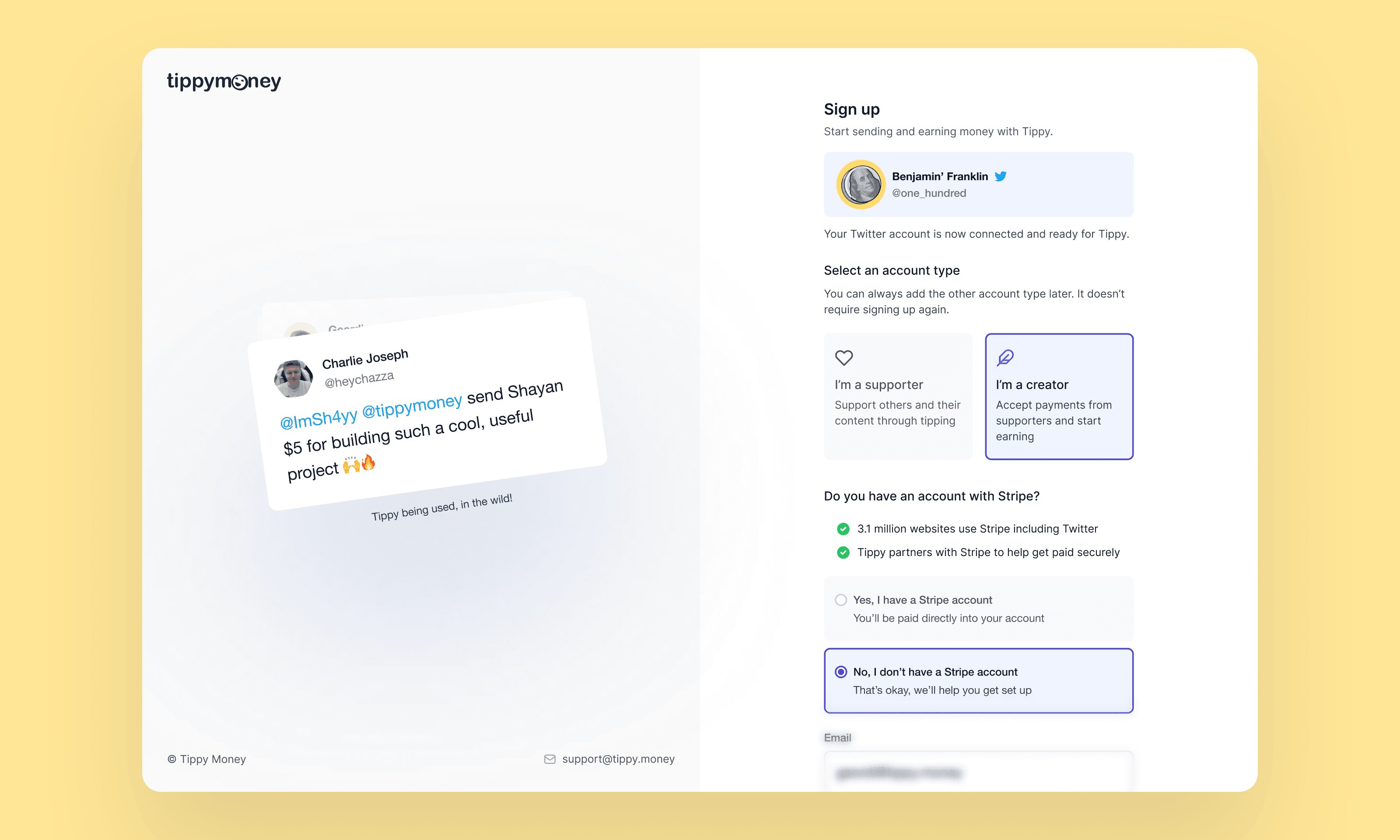
The social interaction was lightweight, but money still required clarity and trust. People needed to understand what Tippy had done, why it was contacting them and what would happen next.
The onboarding experience connected the user’s Twitter account and distinguished between two intentions: supporting other people or accepting tips as a creator. It also made the Stripe setup decision visible rather than hiding payment requirements until later.
This kept the route into the product focused. Users could understand their role, connect the necessary accounts and continue without being introduced to every possible feature at once.
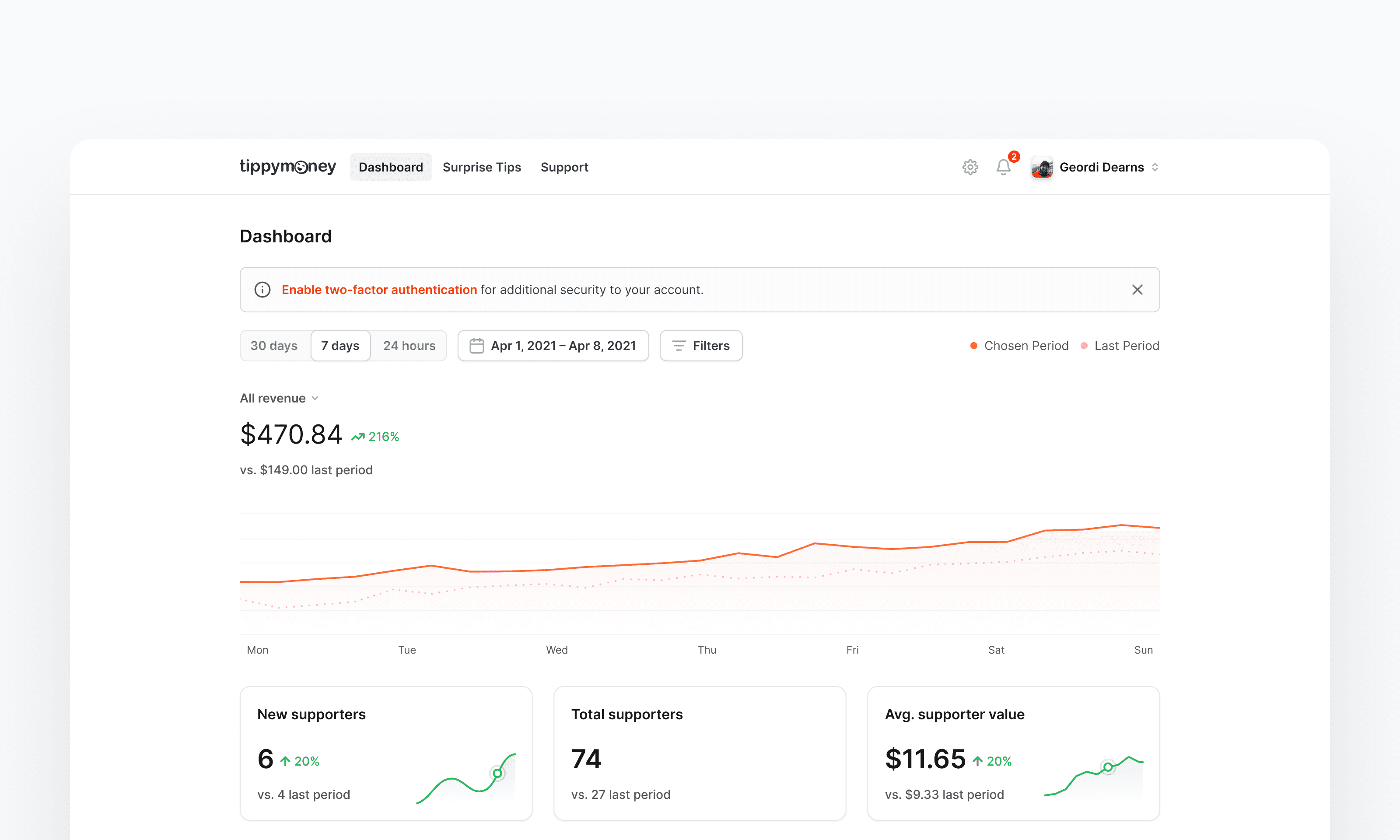
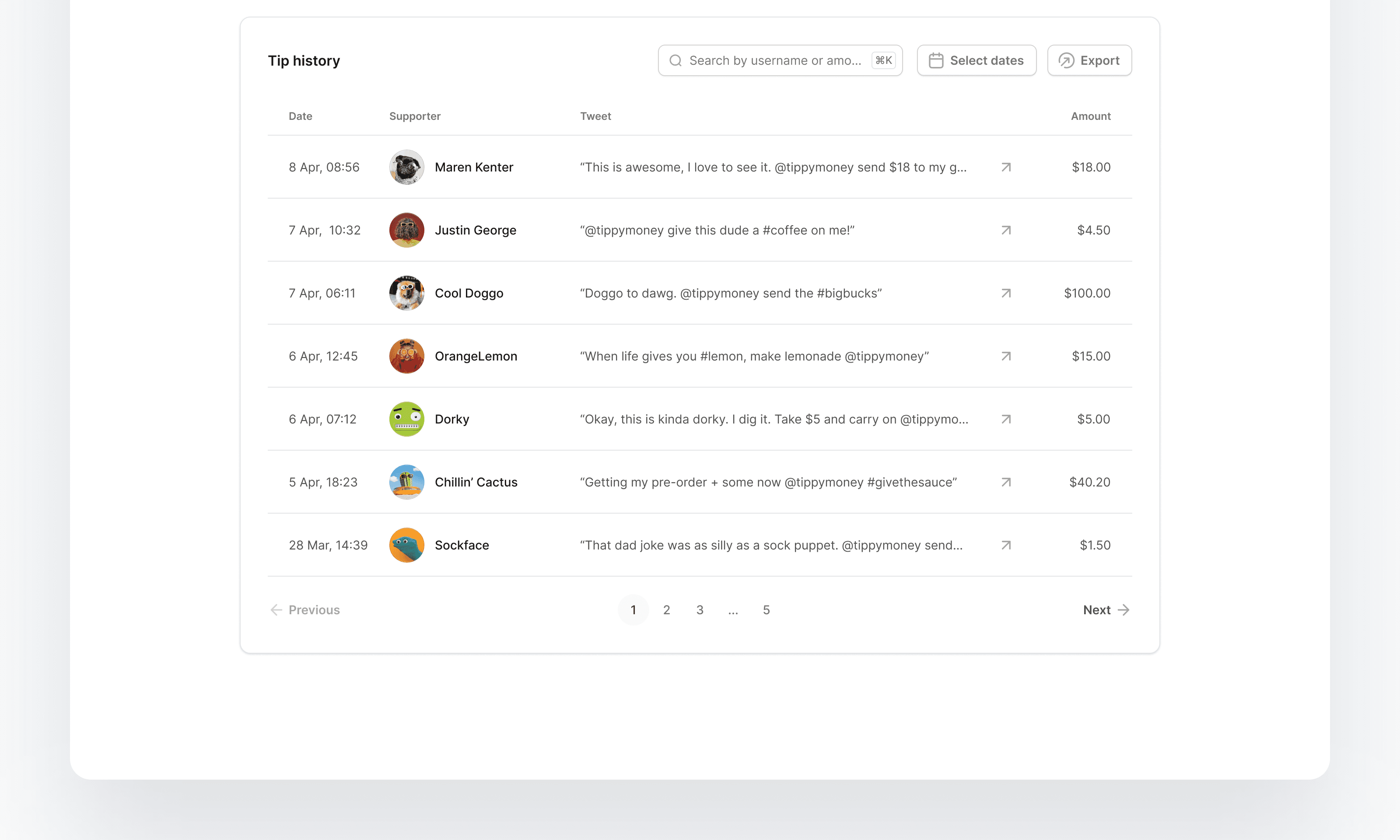
For creators, receiving money was only part of the experience. They also needed to know who had supported them, how much they had received and which interaction prompted the tip.
The dashboard brought revenue, supporters and recent activity into one place. Tip history connected each payment to the supporter and original tweet, making the relationship between the social moment and the transaction easy to scan.
This was important because a tip was not an anonymous payment. It was a visible act of support from someone in the creator’s community.
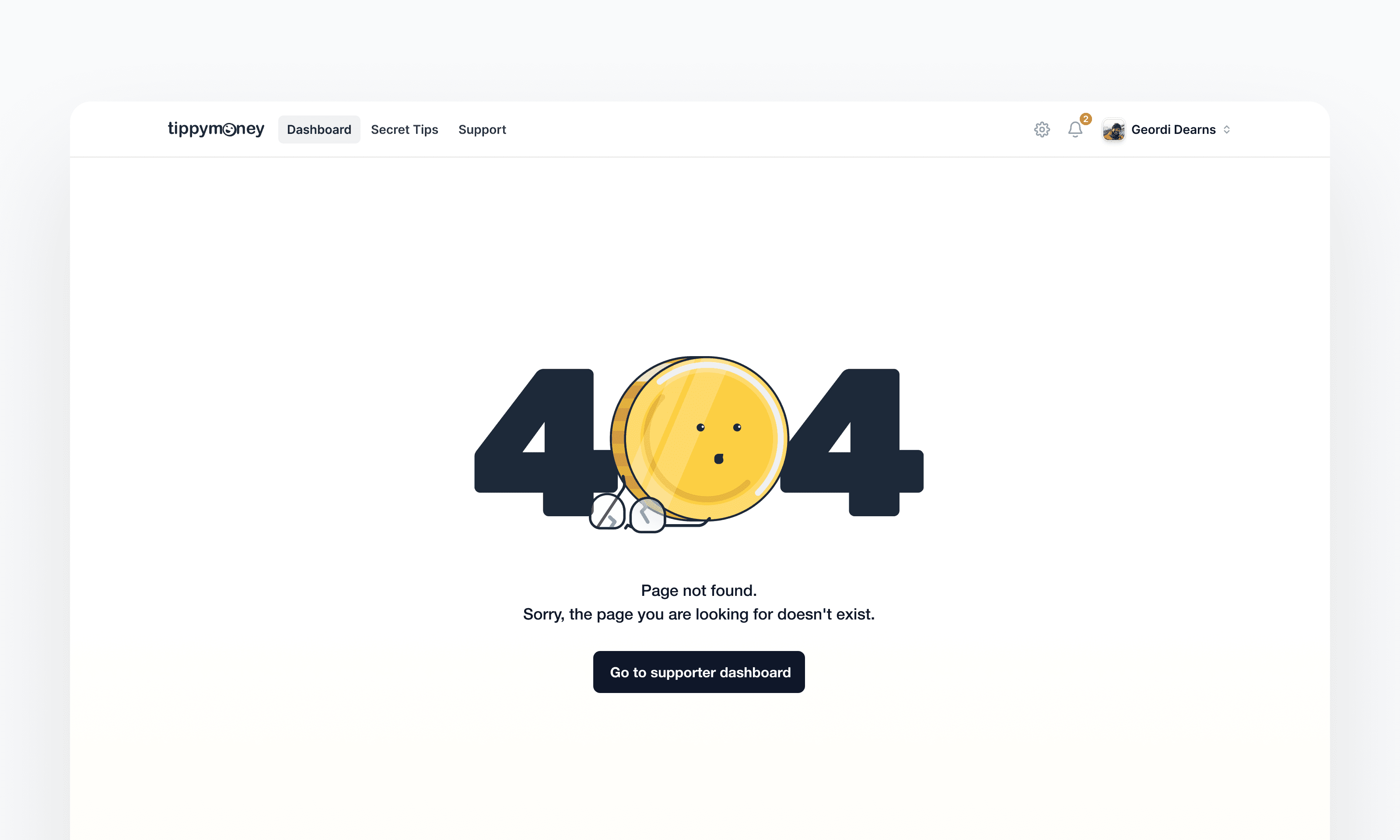
Tippy used a friendly coin character and straightforward language across the product, including supporting states such as the 404 page. This gave the experience personality without making the core actions harder to understand.
The interface remained deliberately restrained. The product centred on onboarding, sending or claiming a tip and understanding activity, rather than adding features before the main transaction loop had been proven.
Tippy’s public interactions created a natural acquisition loop. Recipients joined to claim tips, while other people discovered the product through the conversations happening around them.
The product also gained unexpected interest from gaming communities. Their feedback suggested that the underlying behaviour extended beyond Twitter and helped shape Discord as a potential next platform. This was a future direction rather than part of the original Twitter MVP.
Three choices helped us learn quickly:
We began with a community we could reach directly.
We kept the MVP centred on one complete transaction loop.
We launched quickly enough to learn from real behaviour.
Within its first week, Tippy attracted more than 200 sign-ups and processed over $1,000 in tips. Around two months after the MVP launched, the product was acquired.
The most valuable result was not simply early traffic. The experiment showed that people were willing to send money through a public social interaction and that the same transaction could help others discover the product.
200+ signs ups in the first week
Early interest came from creators, indie hackers and people already supporting each other online.
$1,000+ Tips sent through social interactions
Supporters could send money without leaving the conversation to begin a separate payment journey.
Acquired 2 months after MVP launch
The project moved from a weekend experiment to an acquired product within its first few months.
Tippy reinforced the value of starting with a narrow behaviour and completing the entire loop around it. We did not need to support every platform or creator use case before learning whether social tipping was useful. Beginning with Twitter and a community we understood gave us a faster route to genuine feedback.
If I continued the work, I would define retention and repeat-tipping measures before launch, instrument the journey from invitation to claim and activation, and test trust and payment comprehension more systematically. Those measures would show whether early curiosity was becoming lasting behaviour.
Next case study
Let’s work together.
I’m open to Senior Product Designer roles where complex problems, strong craft and measurable outcomes matter.
hey@razrashid.com
" height="32px" id="hrO0YMoaZ" width="32px"/><path d="M 3.6 16 L 0.2 16 L 0.2 5.3 L 3.6 5.3 Z M 1.9 3.8 C 0.8 3.8 0 3 0 1.9 C 0 0.8 0.9 0 1.9 0 C 3 0 3.8 0.8 3.8 1.9 C 3.8 3 3 3.8 1.9 3.8 Z M 16 16 L 12.6 16 L 12.6 10.2 C 12.6 8.5 11.9 8 10.9 8 C 9.9 8 8.9 8.8 8.9 10.3 L 8.9 16 L 5.5 16 L 5.5 5.3 L 8.7 5.3 L 8.7 6.8 C 9 6.1 10.2 5 11.9 5 C 13.8 5 15.8 6.1 15.8 9.4 L 15.8 16 Z" fill="rgb(255, 255, 255)" height="16.000000190734863px" id="Ocq6OAmI9" transform="translate(8 8)" width="16px"/></svg>)
" height="32px" id="JVzKgZkM5" width="32px"/><path d="M 0 2.667 C 0 1.194 1.194 0 2.667 0 C 4.139 0 5.333 1.194 5.333 2.667 C 5.333 4.139 4.139 5.333 2.667 5.333 C 1.194 5.333 0 4.139 0 2.667 Z" fill="rgb(26, 188, 254)" height="5.333399999999999px" id="ydcjNquk_" transform="translate(15.983 13.333)" width="5.333300000000001px"/><path d="M 0 2.667 C 0 1.194 1.194 0 2.667 0 L 5.333 0 L 5.333 2.667 C 5.333 4.139 4.139 5.333 2.667 5.333 C 1.194 5.333 0 4.139 0 2.667 Z" fill="rgb(10, 207, 131)" height="5.333300000000001px" id="NPUpvGMxn" transform="translate(10.65 18.667)" width="5.333399999999999px"/><path d="M 0 0 L 0 5.333 L 2.667 5.333 C 4.139 5.333 5.333 4.139 5.333 2.667 C 5.333 1.194 4.139 0 2.667 0 Z" fill="rgb(255, 114, 98)" height="5.3332999999999995px" id="jGljsiE4Z" transform="translate(15.983 8)" width="5.333300000000001px"/><path d="M 0 2.667 C 0 4.139 1.194 5.333 2.667 5.333 L 5.333 5.333 L 5.333 0 L 2.667 0 C 1.194 0 0 1.194 0 2.667 Z" fill="rgb(242, 78, 30)" height="5.3332999999999995px" id="JUFtWyYKp" transform="translate(10.65 8)" width="5.333399999999999px"/><path d="M 0 2.667 C 0 4.139 1.194 5.333 2.667 5.333 L 5.333 5.333 L 5.333 0 L 2.667 0 C 1.194 0 0 1.194 0 2.667 Z" fill="rgb(162, 89, 255)" height="5.333399999999999px" id="StHT4lRlg" transform="translate(10.65 13.333)" width="5.333399999999999px"/></svg>)
©
Selected works / Raz